A Close Look at the Packaging You Already Have
A close look at packaging turns one ordinary container into a focused design exercise, revealing how its opening, information, materials and disposal cues guide use.
The common mistake in a close look at packaging is to judge the product inside: whether it is useful, attractive or worth buying again. That shifts attention away from the package, and the afternoon set aside for observation becomes an improvised product review. Choose one familiar container instead, then notice how it guides your hands and attention.
Set aside about twenty minutes: a few minutes to look at the unopened object, then a short interval for each of four features—opening, information, material and disposal cues. There is no need to buy anything or dismantle a package that still serves a purpose. Treat what you notice as evidence of design choices, not as a scorecard.
Choose one package
Pick something already at home: a tea carton, a jar of sauce, a soap wrapper or a delivery box. Choose a package you can examine without making its contents unusable. A sealed food container can stay sealed; its exterior offers plenty to observe.
Set it on a clear table beside a notebook and pencil, or use a phone for brief notes. Begin with the object in its ordinary state. Notice which face is turned towards you, whether you instinctively pick it up or rotate it, and where it normally sits.
Look before writing. This pause separates what you see from what you assume the designer intended. If the package is stained, creased or partly used, record that condition: wear can show where hands regularly meet a surface.
Follow the opening
Find where opening begins. It may be a tab, twist cap, perforated seam, folded flap or edge that invites a fingernail. Note whether that point is visible at once or hidden among printed graphics. Then name the action the package asks your hand to perform: pull, turn, peel, press or separate.
If it is safe and appropriate, open the item once, slowly, without forcing it. Notice whether one action leads to another, such as an outer sleeve before a lid or a seal beneath a cap. Record resistance, looseness or a change in sound as sensory observations, not verdicts. Leave contents undisturbed if opening would compromise freshness or make the package difficult to use.
A raised edge may be easier to find by touch than a small printed arrow. A flap may look obvious but offer little room to grip. Opening is a sequence shared between object and hand, not just a graphic instruction.
Read information order
Turn the package as you would when trying to identify it. Write down the first three things that catch your eye—a name, flavour, illustration, use instruction or warning—before reading smaller text. This records the visual hierarchy: how size, placement, contrast and empty space direct attention.
Next, find practical information such as ingredients or contents, directions, care details, quantity, maker and cautions. Note where it sits and how easily you can return to it after reading the front. Small type may be legible close up yet awkward to scan during use; a fold, seam or curve can interrupt a line.
Rather than deciding that every detail should be larger, observe its order and reading conditions. A narrow bottle has different space to work with than a broad carton. Record what is prominent, what requires turning the package and what seems intended for a later moment.
Notice material feel
Describe the material in plain sensory terms. Is the surface smooth, fibrous, glossy, tacky, soft, rigid or slightly yielding? Does it feel cool, warm, dry or coated? Such words stay closer to what your fingers can verify than a simple judgement of “good” or “bad”.
Look at joins and edges. A paper carton may have a folded seam; a pouch may have layers that feel different inside and out; a jar may pair a hard body with a flexible lid liner. You need not identify every component. For composition or disposal instructions, follow the package wording and any applicable local guidance.
Consider what the feel suggests during use. A textured sleeve may be easier to hold; a slick coating may resist a spill but make a flap harder to grasp. These are observations about the encounter, not claims about the package’s full environmental or manufacturing history.
Find disposal cues
Look for words, symbols and physical features indicating what happens after use. The package may say to recycle, separate parts, remove a label, return a container or use a particular collection stream. A symbol without wording can be easy to misread, so record what is stated rather than guessing from appearance alone.
Check whether separation seems straightforward. Can a lid be removed without tearing the body? Are different materials visibly joined? Does a label cross a seam? Write down the cue and the action it appears to request. Local collection rules differ, so check instructions against guidance where you live.
This is not a judgement of the package’s total impact. The narrower question is how clearly it communicates an after-use action and whether its construction seems to support that action.
What should you record?
How long should the exercise take?
Allow about twenty minutes: a few minutes to observe the package as it sits, followed by roughly four minutes for each feature and a final pause to organise your notes. If a detail needs more time, follow it; otherwise, stop when you have one clear observation under each heading.
Should you open the package?
Only if opening is safe and will not spoil or damage something you still need. The exterior, seams and visible instructions offer plenty to examine without breaking a seal.
What if the package has no disposal advice?
Write “no clear cue observed” and leave the question open. Do not infer local recyclability from a material’s appearance or from a symbol you cannot identify.
How do you avoid turning this into a review?
Describe actions and features instead of assigning a rating. “The tab is tucked under the fold” records an observation; “the package is badly designed” closes the inquiry before you have considered how it is used.
Close with one comparison
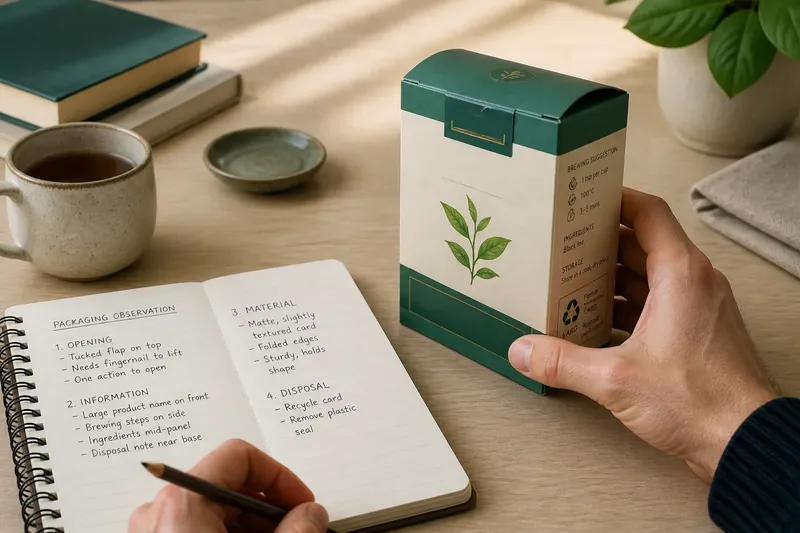
Imagine you choose a tea carton with a tucked flap, a large product name and a small disposal note near its base. You set it on the table, observe that the flap is visible but needs a fingernail to lift, then turn the carton and find the disposal cue. You write those observations under opening and disposal, and note that the product name is readable from your seat. The resulting account describes how the package meets a hand, an eye and an after-use decision without passing judgement on the tea.
Keep the notes to a few lines under four headings: opening, information, material and disposal. Add one sentence about where the package is usually stored, since its surroundings can affect which face is visible or how easily it is handled. Put the notebook away when those observations feel complete.
Researching the package’s entire supply chain is not worth the effort for this exercise, nor is comparing it with a stack of alternatives. Those activities answer different questions and turn observation into evaluation. A close look at packaging stays modest: one object, a short pause and details you can see or feel for yourself.
Keep the notes if you want to repeat the routine with a different object another day. The contrast will come from the objects’ distinct arrangements, not from ranking them. Even a plain wrapper can reveal how much design happens in the small instructions accompanying an ordinary act.