The Open Shelf Does Not Automatically Make a Room Feel Bigger
Open shelving can make a room feel busier, not larger. See how shelf rhythm, visible clutter and sightlines shape the impression of space.
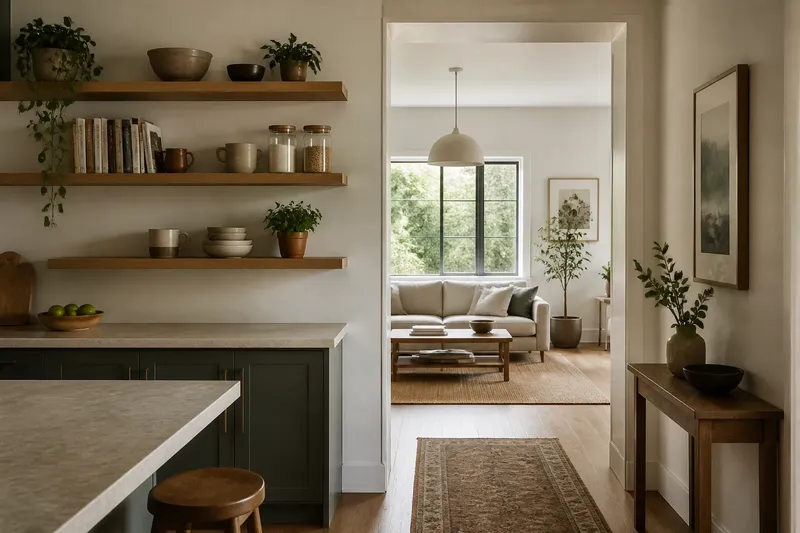
The most common mistake with open shelving is treating an empty wall as wasted space and filling it with visible storage. The cost is not only more things to dust: a crowded shelf can break up the room’s sightlines and make its boundaries feel closer. Open shelves make a room feel bigger only when what they reveal is quieter than the wall they replace.
Space is a visual impression
A shelf does not add floor area. It changes what the eye encounters on the way across a room. A plain wall gives the gaze an uninterrupted surface; shelves introduce horizontal lines, shadows, objects and gaps. Depending on their arrangement, those details can lend a wall depth or make it feel densely occupied.
Three features matter especially: repetition, clutter and sightlines. Repetition gives the eye a pattern it can follow. Clutter creates many competing points of attention. Sightlines determine whether the view continues through the room or stops at a busy patch. These effects are connected, but they are not interchangeable: neatly repeated objects may still form a heavy band, while a varied arrangement can remain visually light if it leaves enough clear wall and open view.
Three shelf approaches
One continuous run
A long run of shelves creates a strong horizontal line. That can suit a room with a low, uninterrupted wall, especially when the shelves hold a restrained collection of similar forms: books of related height, matching storage boxes or a small group of plain crockery. The repeated line helps the wall read as one composition rather than a set of scattered fixtures.
It is less helpful where the run cuts across a doorway, window view or the line between connected rooms. A continuous band loaded with objects can draw attention to the wall and make it feel more substantial. Choose this approach when the shelves have a clear start and finish and the display can remain visually consistent.
Short, separate shelves
Several shorter shelves leave more wall visible and can suit a narrow kitchen, a compact study or a room where a full run would interrupt an important view. Their separation creates pauses, so the eye can move between shelf and wall instead of reading one dense strip. A few carefully grouped objects may look more spacious than the same objects spread across a long run.
However, isolated shelves can appear fussy if each carries a different assortment. They suit readers who want to display a small, changing collection and are willing to leave some shelves partly empty. If every gap prompts another purchase or object to be added, the visual pause disappears.
One display zone
Concentrating open shelving in a single zone leaves other walls clear. This can work well when one part of the room already has a natural purpose, such as a reading corner or a kitchen work area. A defined display zone is easier to keep coherent than shelves scattered across several walls, and it allows the rest of the room to retain uninterrupted surfaces.
This option suits people who need visible storage but do not want every wall to carry it. It is a weaker choice if the shelving zone sits directly in the main view from a doorway and holds a mix of daily supplies, paperwork and decorative objects. The distinction between useful storage and display then becomes hard to read.
Repetition and clutter
Repetition can settle a shelf, but too much uniformity can turn it into a solid visual block. A row of similarly sized book spines or a few matching jars gives the eye an easy pattern; adding contrasting shapes, labels and small loose items makes that pattern harder to follow. The question is not whether every object matches, but whether the arrangement has a legible rhythm.
Clutter is often a matter of competing edges rather than sheer quantity. A stack of books, a framed print and one bowl may form a clear group. The same shelf can feel busier when receipts, cables, bright packaging and small objects overlap its outlines. Keep objects that serve different purposes in distinct groups, and let some stretches of shelf remain empty.
Say you have a short kitchen wall beside a doorway, with cookbooks, mugs and packets currently spread across several shelves. If you move the packets into a closed cupboard, group the cookbooks together and leave the shelf nearest the doorway clear, the view may feel less interrupted even though the shelves remain. The useful change is not extra space but fewer competing details along the room’s main sightline.
Protecting sightlines
Stand at the entrance and look towards the farthest visible point. Notice where the shelf begins in that view, whether objects sit against a bright window, and whether the shelves overlap a doorway or passage. A display can look airy from directly in front and feel obstructive from the angle that matters most in daily use.
Height and depth affect that view as well. Objects with tall, irregular outlines create a more broken horizon than a low, continuous group. Deep shelves can cast stronger shadows and project further into the room; shallow shelves may keep the wall’s plane more apparent. If people move through the space carrying bags, dishes or laundry, leave the route and its visual opening clear rather than treating every empty wall section as display capacity.
Lighting also changes how a shelf reads. A shadowed recess can make objects merge into a dark band, while bright light on glossy or varied surfaces can make each item stand out. Consider the room in its ordinary lighting, not only in a carefully arranged photograph. A display that disappears into the background at one time of day may dominate at another.
Which arrangement suits you?
Choose a continuous run if the wall is visually simple, the collection is consistent and a strong horizontal line supports the room. Choose separate shelves if you value visible wall between objects and can resist filling every gap. Choose one display zone if you need open storage but want the remaining walls to stay calm.
A useful way to decide is to look at what the room needs the shelves to do. If they hold everyday objects that are awkward to store elsewhere, arrange them for access first and reduce visual competition through grouping. If their main purpose is display, edit more firmly and treat the empty wall around them as part of the composition. If the shelf dominates the view from the doorway, moving or shortening it may matter more than rearranging its contents.
Questions about open shelves?
Do open shelves make a small room look bigger?
Not automatically. They can preserve an open wall impression when their contents are restrained and the main sightline remains clear, but a dense display can make the wall seem more occupied than a closed cupboard would.
Are fewer objects always better?
Fewer competing shapes often make an arrangement easier to read, but a small number of unrelated objects can still look scattered. Grouping objects by use, form or colour can create a clearer pattern without requiring a bare shelf.
Should open shelves match the wall?
A shelf close in tone to the wall may recede, while a contrasting shelf makes its line more prominent. Neither choice is inherently more spacious; consider whether the room benefits from a quiet surface or a deliberate horizontal feature.
What is not worth the effort?
There is little value in repeatedly arranging small decorative objects to create a perfect photograph while daily items continue to collect in the same place. Decide which things genuinely belong within reach, group them sensibly and leave the rest of the room’s sightlines alone.
A room to read clearly
Open shelving is not a shortcut to a larger-feeling room; it is a way of deciding which parts of the wall and its contents remain visible. Before adding another shelf, look from the doorway, identify the lines the eye follows and ask whether the display supports or interrupts them. That small pause often tells you whether the room needs more shelving, a tighter arrangement or simply a stretch of wall left open.