Why a Spoon Bowl Has Its Shape
Why a spoon bowl has its shape comes down to what it must hold, lift and release, helping you choose a spoon that feels right for its task.
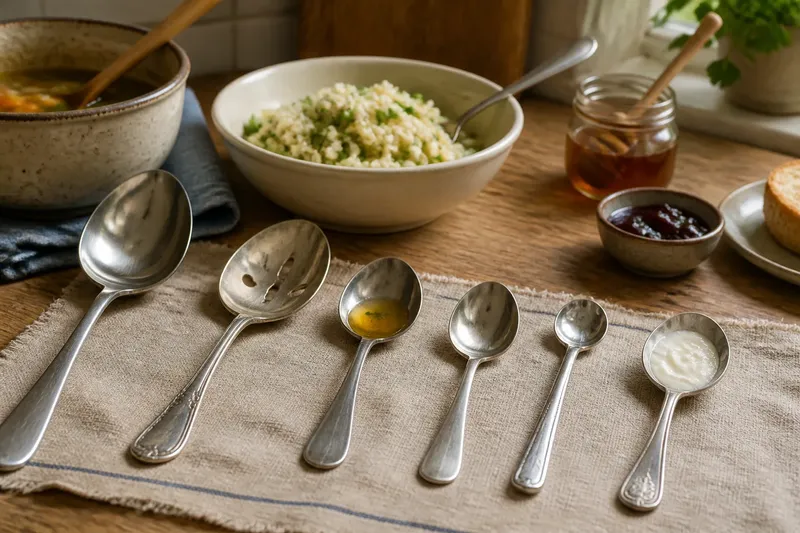
The most common mistake is judging a spoon by its handle or decoration and treating the bowl as a minor detail. But why a spoon bowl has its shape is a question of use: the curve determines what the spoon can gather, how securely it carries it and how readily it lets it go.
Look at the bowl, handle and balance together. Their proportions make a spoon suited to sipping, serving, stirring or eating from a plate. These five observations offer a practical way to read that relationship in an ordinary kitchen drawer.
1. Bowl depth holds liquid
A deeper bowl can carry a fuller mouthful of broth or sauce, while a shallow one spreads its contents into a thin layer. That difference affects not only capacity but also how the liquid behaves as the spoon moves. A steep inner curve contains liquid more readily; a flatter, wide bowl makes a small quantity easier to spread or inspect.
Depth also shapes the rim. A rounded, high edge helps keep a spoonful from spilling during a short lift, but it can feel bulky at the lips. A low edge is easier to approach and can make a spoon comfortable for tasting, although it offers less containment when the hand tilts.
Try the distinction with water in two spoons of similar length. Hold each level, then tip it gently over a sink. Notice how much motion is needed before the water leaves the bowl. This simple observation is more useful than assuming that a deeper spoon is always better: a spoon intended for sipping has different demands from one used to spread jam.
2. Width suits the target
A broad bowl can gather a larger portion of soft food, such as rice or yoghurt, and can cover more of a shallow dish with each pass. A narrow bowl fits more easily into a small jar, a narrow cup or the gap between pieces of food. The useful width is therefore tied to the space the spoon must enter as well as to the food it must carry.
Shape at the tip matters too. A rounded end sweeps smoothly through a bowl; a slightly pointed end can reach into a corner or separate a bite. Neither shape is universally superior. A spoon that is easy to manoeuvre in a saucepan may feel awkward at a small dessert dish, where a compact tip can be more precise.
Say you keep reaching for a long-handled spoon to get honey from a narrow jar, but its wide bowl catches on the neck. Choosing a narrower bowl with a similar reach would let it enter cleanly and lift a small amount without scraping the rim. The observable difference is less contact with the jar, not a promise that one spoon suits every jar.
3. The handle controls approach
The bowl only works if the handle brings it to the food at a useful angle. A long handle helps reach into a tall vessel and keeps the hand farther from its contents. A shorter one offers closer control at the table, where the spoon travels from plate to mouth over a compact path.
Some handles continue straight from the bowl; others rise, dip or curve. That change in line affects where the fingers sit and how the bowl meets the surface. A raised handle can help the bowl reach over a high rim, while a nearly straight profile may rest more naturally in a shallow dish. It is the relationship between handle and bowl that matters, not the handle’s outline in isolation.
When comparing spoons, hold each as you would during its intended task. For stirring, make a small circular motion in an empty mug. For eating, bring the bowl towards the mouth without twisting the wrist. Notice whether the bowl stays level and whether the handle encourages a relaxed grip. A spoon can look balanced on a table yet feel poorly aligned in the hand.
4. The curve meets the surface
The underside and rim determine how well a spoon works against a plate or vessel. A bowl with a flatter underside can sit more steadily on a surface and may scrape a broad area in one pass. A deeper underside can scoop more readily from loose food, but may leave a thin layer behind when drawn across a flat plate.
The rim’s edge also changes how food releases. A thin, defined edge can slide beneath a soft piece or collect a smear cleanly. A thick, rounded edge feels less sharp against a dish, but can push a soft spread ahead of it rather than lifting it. For a serving spoon, that may be unimportant; for a small tasting spoon, it can alter how accurately a little food reaches the mouth.
Do not confuse a polished finish with a useful curve. A reflective surface may make the bowl easy to see, but it does not tell you whether its edge will reach the corners of a container or its underside will follow a plate. Those are questions to answer by looking at the spoon from the side and, if practical, trying its motion with the relevant vessel.
5. Balance follows the load
A spoon’s balance is the way its weight is distributed between handle and bowl. If the bowl feels heavy, the hand may need to steady it more carefully during a lift. If the handle dominates, a loaded spoon can feel as though it is tipping forward. The right balance depends on what the spoon carries and how far it travels.
A long-handled serving spoon may need enough weight and length to reach into a deep dish, while a small spoon used for tasting benefits from nimble control. Material and thickness contribute to the sensation, but there is no single ideal weight. A spoon that feels reassuring when serving a dense stew may seem cumbersome when stirring tea.
When handling, pay attention to the moment the bowl leaves a surface. Does it rise smoothly, or does the wrist have to correct its angle? That small movement reveals more about balance than resting the spoon across a finger, which says little about how it behaves with food in the bowl.
Which spoon shape suits the task?
Why are soup spoons often deeper?
A deeper bowl can contain liquid during a lift and bring a fuller spoonful towards the mouth. Its usefulness depends on its width and rim as well: a deep bowl that is too broad for the diner or vessel may be awkward to approach.
What makes a serving spoon different?
A serving spoon usually needs to gather a portion from a larger dish, so its bowl is commonly broader or deeper than that of a small eating spoon. The handle also needs to provide reach and control without forcing the wrist into an uncomfortable angle.
Does a wider bowl always hold more?
Not necessarily. A wide, shallow bowl can spread a portion thinly, while a narrower, deeper bowl may contain more liquid. Compare both the inner depth and the overall width, then consider the food and container involved.
Choose by hand and vessel
For a useful comparison, set aside decoration and ask what the spoon must enter, gather and carry. A narrow jar, shallow plate, deep mug and serving dish each place different demands on bowl width, depth, rim and handle length. If the spoon feels awkward, identify the movement that causes trouble rather than dismissing the whole shape.
It is not worth pursuing tiny differences in bowl curvature if the spoon already reaches the food comfortably and feels steady in use. Focus instead on the point where it meets a vessel or changes direction in the hand. That is where the reason for its shape becomes clearest: why a spoon bowl has its shape is answered by the path its contents take from dish to destination.